
Fasting Rules
 Meat
Allowed
 Fish
Allowed
 Dairy
Allowed
 Oil
Allowed
 Wine
Allowed
Saints & Commemorations
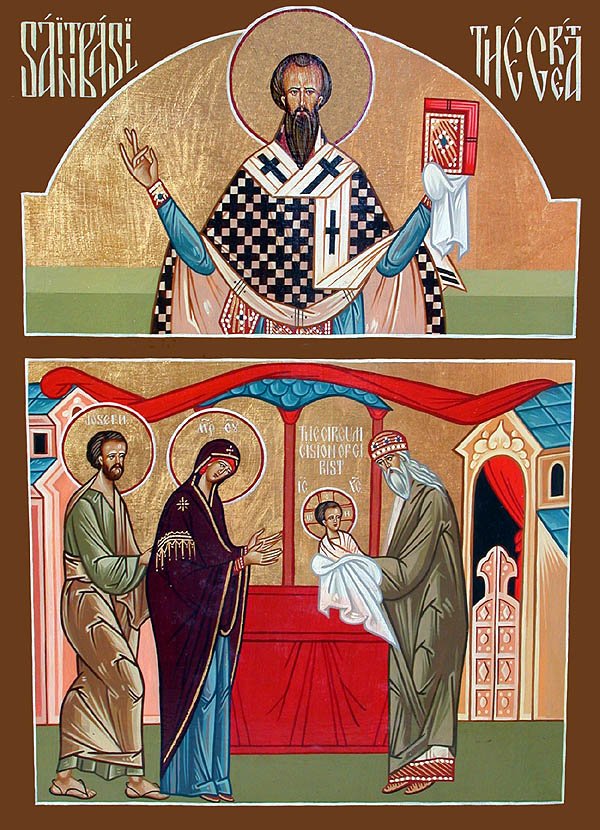
Circumcision of Our Lord
On the eighth day after His Nativity , our Lord Jesus Christ was circumcised in accordance with the Old Testament Law. All male infants underwent circumcision as a sign of God’s Covenant with the holy Forefather Abraham and his descendants [Genesis 17:10-14, Leviticus 12:3].
After this ritual, the Divine Infant was given the name Jesus, as the Archangel Gabriel declared on the day of the Annunciation to the Most Holy Theotokos [Luke 1:31-33, 2:21]. T
On the eighth day after His Nativity , our Lord Jesus Christ was circumcised in accordance with the Old Testament Law. All male infants underwent circumcision as a sign of God’s Covenant with the holy Forefather Abraham and his descendants [Genesis 17:10-14, Leviticus 12:3].
After this ritual, the Divine Infant was given the name Jesus, as the Archangel Gabriel declared on the day of the Annunciation to the Most Holy Theotokos [Luke 1:31-33, 2:21]. The Fathers of the Church explain that the Lord, the Creator of the Law, underwent circumcision in order to give people an example of how faithfully the divine ordinances ought to be fulfilled. The Lord was circumcised so that later no one would doubt that He had truly assumed human flesh, and that His Incarnation was not merely an illusion, as certain heretics had taught.
In the New Testament, the ritual of circumcision gave way to the Mystery of Baptism, which it prefigured [Colossians 2:11-12]. Accounts of the Feast of the Circumcision of the Lord continue in the Eastern Church right up through the fourth century. The Canon of the Feast was written by Saint Stephen of the Saint Savva Monastery .
In addition to circumcision, which the Lord accepted as a sign of God’s Covenant with mankind, He also received the Name Jesus [Savior] on the eighth day after His Nativity as an indication of His service, the work of the salvation of the world [Matthew 1:21; Mark 9:38-39, 16:17; Luke 10:17; Acts 3:6, 16; Philippians 2:9-10]. These two events -- the Lord’s Circumcision and Naming -- remind Christians that they have entered into a New Covenant with God and “are circumcised with a circumcision made without hands, in putting off the body of the sins of the flesh by the circumcision of Christ” [Colossians 2:11]. The very name “Christian” is a sign of mankind’s entrance into a New Covenant with God.
Troparion - Tone 1
Enthroned on high with the Eternal Father and Your divine Spirit, / O Jesus, You willed to be born on earth of the unwedded handmaid, your Mother. / Therefore You were circumcised as an eight-day old Child. / Glory to Your most gracious counsel; / glory to Your dispensation; / glory to Your condescension, O only Lover of mankind.
Kontakion - Tone 3
The Lord of all accepts to be circumcised, / thus, as He is good, excises the sins of mortal men. / Today He grants the world salvation, / while light-bearing Basil, high priest of our Creator, / rejoices in heaven as a divine initiate of Christ.
Our Father among the Saints Basil the Great (379).
The Hieromartyr Basil (Sitnikov) was a deacon of the Dalmatov - Saint Nicholas Church in the province of Perm. He graduated from the three classes of the religious school, and beginning in 1885, he served as a Reader. In 1898, he was ordained as a deacon, serving first at Saint John the Baptist Church in the village of Izyeduga in the Shadrinsk district of the Yekaterinburg diocese.
The Hieromartyr Basil (Sitnikov) was a deacon of the Dalmatov - Saint Nicholas Church in the province of Perm. He graduated from the three classes of the religious school, and beginning in 1885, he served as a Reader. In 1898, he was ordained as a deacon, serving first at Saint John the Baptist Church in the village of Izyeduga in the Shadrinsk district of the Yekaterinburg diocese. Later, he served in the Church of the Nativity of the Theotokos in the village of Baklanskoye in that same district.
On November 5, 1913, he was transferred to the Saint Nicholas Church in the city of Dalmatov, where he was put to death by the atheists who had come to power. In 1918, after the priests Vladimir Sergeiev and Alexander Sidorov were arrested, Deacon Basil began to reproach the atheists for plundering the property of these arrested shepherds. They took note of this and got their revenge. Deacon Basil Sitnikov was killed on the day after the priests with whom he served, on June 28, 1918.
Troparion - Tone 4
By sharing in the ways of the Apostles, / you became a successor to their throne. / Through the practice of virtue, you found the way to divine contemplation, O inspired one of God; / by teaching the word of truth without error, you defended the Faith, / even to the shedding of your blood. / Hieromartyr Basil, entreat Christ God to save our souls.
Telemachos the Martyr
St Gregory, Bishop of Nazianzus (374), father of St Gregory the Theologian
He converted to Christianity from paganism as an adult through the influence of his pious wife St Nonna (Aug. 5). He was made Bishop of Nazianzus in Cappadocia in 329, and served faithfully for forty-five years, defending his flock against the inroads of Arianism and the persecutions of Julian the Apostate.
He converted to Christianity from paganism as an adult through the influence of his pious wife St Nonna (Aug. 5). He was made Bishop of Nazianzus in Cappadocia in 329, and served faithfully for forty-five years, defending his flock against the inroads of Arianism and the persecutions of Julian the Apostate. Late in life, he ordained his son Gregory, later known as St Gregory the Theologian (Jan. 25) to assist him. He reposed in peace, aged almost 100.
Scripture Readings
☩Epistle
Colossians 2:8-12
8
Beware lest any man spoil you through philosophy and vain deceit, after the tradition of men, after the rudiments of the world, and not after Christ.
9
For in him dwelleth all the fulness of the Godhead bodily.
10
And ye are complete in him, which is the head of all principality and power:
11
In whom also ye are circumcised with the circumcision made without hands, in putting off the body of the sins of the flesh by the circumcision of Christ:
12
Buried with him in baptism, wherein also ye are risen with him through the faith of the operation of God, who hath raised him from the dead.
☩Gospel
Luke 2:20-21, 40-52
20
And the shepherds returned, glorifying and praising God for all the things that they had heard and seen, as it was told unto them.
21
And when eight days were accomplished for the circumcising of the child, his name was called JESUS, which was so named of the angel before he was conceived in the womb.
40
And the child grew, and waxed strong in spirit, filled with wisdom: and the grace of God was upon him.
41
Now his parents went to Jerusalem every year at the feast of the passover.
42
And when he was twelve years old, they went up to Jerusalem after the custom of the feast.
43
And when they had fulfilled the days, as they returned, the child Jesus tarried behind in Jerusalem; and Joseph and his mother knew not of it.
44
But they, supposing him to have been in the company, went a day’s journey; and they sought him among their kinsfolk and acquaintance.
45
And when they found him not, they turned back again to Jerusalem, seeking him.
46
And it came to pass, that after three days they found him in the temple, sitting in the midst of the doctors, both hearing them, and asking them questions.
47
And all that heard him were astonished at his understanding and answers.
48
And when they saw him, they were amazed: and his mother said unto him, Son, why hast thou thus dealt with us? behold, thy father and I have sought thee sorrowing.
49
And he said unto them, How is it that ye sought me? wist ye not that I must be about my Father’s business?
50
And they understood not the saying which he spake unto them.
51
And he went down with them, and came to Nazareth, and was subject unto them: but his mother kept all these sayings in her heart.
52
And Jesus increased in wisdom and stature, and in favour with God and man.
Liturgical data sourced from OCA.org and orthocal.info