• Skip to main content
  • Skip to after header navigation
  • Skip to site footer
St Nina Orthodox Church

St Nina Orthodox Church

  • Home
  • About Us
    • Mission Statement
    • What is Orthodoxy?
    • Saint Nina Of Georgia
    • Parish History
    • Primate, Clergy, and Mission Council
  • Visit Us
    • What to Know
    • Calendar
    • Directions & Map
  • Media
  • Ministries
  • Give
  • Contact Us
CALENDAR OF SERVICES
saints of the day
scripture readings
music & TExts

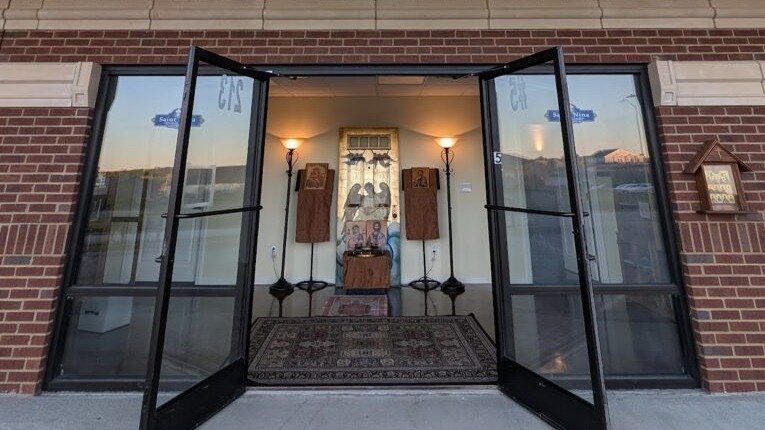
We welcome all visitors to our Orthodox chapel, located in Berea, KY! St. Nina Orthodox Mission — founded in 2021 — is itself a daughter of a now-large parish, St. Athanasius Orthodox Church in Nicholasville, that began as a small mission back in 2002. Both our mother parish and our daughter mission are blessed to have many visitors. We invite you to “come and see.”

Our full calendar for all events in our mission over the next several months is here. All evening services now begin at 630pm. Here is our calendar for Holy Week, Paschaltide, and April, service by service:

  • Lazarus Sat., April 4: 630pm Vespers for Palm Sunday & Confessions (Fr. Giorgi)
  • Palm Sunday, April 5: 7pm Bridegroom Matins & Confessions (Fr. Justin)
  • Holy Monday, April 6: 9am Presanctified Liturgy (Fr. David)
    • Fr. Justin will hear Confessions starting at 8am on Holy Monday
  • Holy Tuesday, April 7: 630pm Bridegroom Matins (Fr. David)
  • Holy Friday, April 10: 12pm Entombment Vespers (Fr. David)
  • Note: we have only 5 Holy Week services @ ST. NINA. All other services — including PASCHA — will be offered daily at our mother parish. See the St. Athanasius schedule here.
  • Bright Tuesday, April 14: 630pm Paschal Vespers & Festive Dinner (Fr. David)
  • Bright Saturday, April 18: Bright Sat. Pinnacles Hike (details TBA)
  • Bright Saturday, April 18: 630pm Great Vespers & Confessions (Fr. Justin)
  • Thomas Sunday, April 19: 930am Paschal Liturgy & Picnic @ Memorial Park (Fr. J)
  • Tuesday, April 21: 630pm Vespers & Class (TBA) (Fr. David)
  • Saturday, April 25: 630pm Lay Vespers (no priest)
  • Tuesday, April 28: 630pm Vespers & Class (Fr. David)

Here are some recent photos of community life at St. Nina chapel in Berea:

Sidebar

Comments Box SVG iconsUsed for the like, share, comment, and reaction icons
Cover for St. Nina Orthodox Christian Church
1
St. Nina Orthodox Christian Church

St. Nina Orthodox Christian Church

The St. Nina Orthodox Church is a chapel ministry (or mission station) of St. Athanasius Orthodox Church, which is itself a parish of the Diocese of the South of the Orthodox Church in America (OCA.)

Author Avatar
St. Nina Orthodox Christian Church
12 hours ago

April 23 is the Feast of St. George the Great-Martyr, one of the most beloved saints in all of Christian history!

St. George was born to a Christian noble family in Lydda, Syria Palestina, during the late third century between about 275 AD and 285 AD. He suffered as a "great-martyr" for Christ -- meaning his sufferings were repeated and extended -- in Nicomedia in Asia Minor.

His father, Gerontios, was from Cappadocia, an officer in the Roman army; his mother, Polychronia, was a native of Lydda in Syria. They were both Christians from noble families, so their child was raised with Christian beliefs. They decided to call him Georgios, meaning "worker of the land" (i.e., farmer). At the age of 14, George lost his father; a few years later, George's mother, Polychronia, died.
George then decided to go to Nicomedia and present himself to Emperor Diocletian to apply for a career as a soldier. Diocletian welcomed him with open arms, as he had known his father, Gerontius โ€” one of his finest soldiers. By his late 20s, George was promoted to the rank of Tribunus and stationed as an imperial guard of the Emperor at Nicomedia.

On 24 February AD 303, Diocletian (influenced by his junior co-ruler Galerius) issued an edict that every Christian soldier in the army should be arrested and that every soldier should offer a sacrifice to the Roman gods. However, George objected, and with the courage of his faith in Christ, approached the Emperor and ruler. Diocletian was upset, not wanting to lose his best tribune and the son of his best official, Gerontius. But George loudly renounced the Emperor's edict, and in front of his fellow soldiers and tribunes he claimed himself to be a Christian and declared his worship of Jesus Christ. Diocletian attempted to convert George, even offering gifts of land, money, and slaves if he made a sacrifice to the Roman gods; he made many offers, but George categorically refused.

Recognizing the futility of his efforts and insisting on upholding his edict, Diocletian ordered that George be executed for his refusal. Before the execution, George gave his wealth to the poor and prepared himself for what was to come. After various extended tortures, including laceration on a wheel of swords during which he was revived three times, George was executed by decapitation before Nicomedia's city wall, on 23 April 303. Witnessing these exctruciating sufferings and bold faith, the Empress Alexandra and Athanasius -- a pagan priest -- become Christians. They ultimately joined George in martyrdom.

After the legalization of the Christian Faith, St. George's body was returned to Lydda for burial, where Christians lovingly honored him as a martyr and powerful intercessor before God.

In some accounts of St. George, the story of "St. George and the dragon" plays a prominent role. It is said that a dragon made its nest at the spring that provided water for a certain city in Syria. Consequently, the citizens had to dislodge or distract the dragon from its nest to collect water. To do so, each day they were compelled to offer the dragon (at first) a sheep; but (eventually) the dragon required a maiden. In this pagan city, the victim was chosen by drawing lots. One day, this happened to be a local nobleman's daughter. The nobleman begged for her life to be spared, but to no avail. She was offered to the dragon, but then the heroic Saint George appeared -- while on his way travelling -- and intervened. He faced the dragon, protected himself with the sign of the Cross, slew the dragon, and rescued the princess. It was said that -- in this face of this miracle and power -- the entire citizenry of that area abandoned their worship of the idols and embraced Christ.

St. George's patronage is widespread. Among the places that recognize him as their heavenly patron would be England, Georgia, Aragon, Catalonia, Ethiopia, Palestine, Moscow (and many other cities.) He is also patron for agricultural workers, farmers, field workers; soldiers; archers; armourers; equestrians, cavalry, saddle makers; peacekeeping missions; skin diseases, lepers and leprosy, syphilis; sheep, shepherds, and boy scouts.

Holy Father George, pray to God for us!
... See MoreSee Less

April 23 is the Feas
View on Facebook
· Share
Share on Facebook Share on Twitter Share on Linked In Share by Email
View Comments likes 3 Shares: 2 Comments: 0

0 CommentsComment on Facebook

Author Avatar
St. Nina Orthodox Christian Church
22 hours ago

Many years to Fr. Giorgi Lomsadze on his Nameday, the Feast of St. George!Happy Nameday to Fr. Giorgi and to all those who bear the august name of St. George! We keep the Feast with a 7am Thursday Liturgy. ... See MoreSee Less

Many years to Fr. Gi
View on Facebook
· Share
Share on Facebook Share on Twitter Share on Linked In Share by Email
View Comments likes love 7 Shares: 0 Comments: 1

1 CommentsComment on Facebook

Author Avatar
St. Nina Orthodox Christian Church
2 days ago

The mother lode -- 194 photos from both St. Athanasius & St. Nina showing the Holy Week to Pascha journey! ... See MoreSee Less

Image attachment
Image attachment
Image attachment
Image attachment
Image attachment
View on Facebook
· Share
Share on Facebook Share on Twitter Share on Linked In Share by Email
View Comments likes love 11 Shares: 0 Comments: 0

0 CommentsComment on Facebook

Load more

St. Nina Mission is located just off I-75 at Exit 77 at 213 Pauline Drive #5, Berea KY 40403

© 2026 ยท St Nina Orthodox Church