
Fasting Rules
 Meat
Abstain
 Fish
Abstain
 Dairy
Abstain
 Oil
Abstain
 Wine
Abstain
Saints & Commemorations
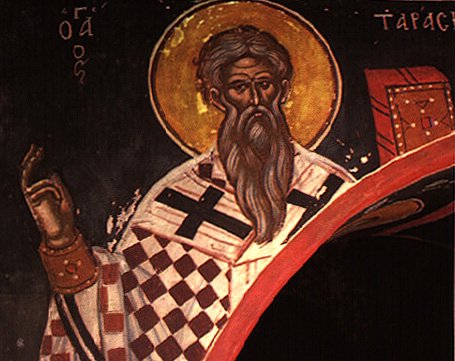
Saint Tarasius, Archbishop of Constantinople
Saint Tarasius, Patriarch of Constantinople was of illustrious lineage. He was born and raised in Constantinople, where he received a fine education. He was rapidly promoted at the court of the emperor Constantine VI Porphyrogenitos (780-797) and Constantine’s mother, the holy Empress Irene (August 7), and the saint attained the rank of senator.
Saint Tarasius, Patriarch of Constantinople was of illustrious lineage. He was born and raised in Constantinople, where he received a fine education. He was rapidly promoted at the court of the emperor Constantine VI Porphyrogenitos (780-797) and Constantine’s mother, the holy Empress Irene (August 7), and the saint attained the rank of senator.
During these times the Church was agitated by the turmoil of the Iconoclast disturbances. The holy Patriarch Paul (August 30) although he had formerly supported Iconoclasm, later repented and resigned his office. He withdrew to a monastery, where he took the schema. When the holy Empress Irene and her son the emperor came to him, Saint Paul told them that the most worthy successor to him would be Saint Tarasius (who at this time was still a layman).
Tarasius refused for a long time, not considering himself worthy of such high office, but he then gave in to the common accord on the condition, that an Ecumenical Council be convened to address the Iconoclast heresy.
Proceeding through all the clerical ranks in a short while, Saint Tarasius was elevated to the patriarchal throne in the year 784. In the year 787 the Seventh Ecumenical Council was convened in the city of Nicea, with Patriarch Tarasius presiding, and 367 bishops attending. The veneration of holy icons was confirmed at the council. Those bishops who repented of their iconoclasm, were again received by the Church.
Saint Tarasius wisely governed the Church for twenty-two years. He led a strict ascetic life. He spent all his money on God-pleasing ends, feeding and giving comfort to the aged, to the impoverished, to widows and orphans, and on Holy Pascha he set out a meal for them, and he served them himself.
The holy Patriarch fearlessly denounced the emperor Constantine Porphyrigenitos when he slandered his spouse, the empress Maria, the granddaughter of Saint Philaretos the Merciful (December 1), so that he could send Maria to a monastery, thus freeing him to marry his own kinswoman. Saint Tarasius resolutely refused to dissolve the marriage of the emperor, for which the saint fell into disgrace. Soon, however, Constantine was deposed by his own mother, the Empress Irene.
Saint Tarasius died in the year 806. Before his death, devils examined his life from the time of his youth, and they tried to get the saint to admit to sins that he had not committed. “I am innocent of that of which you accuse me,” replied the saint, “and you falsely slander me. You have no power over me at all.”
Mourned by the Church, the saint was buried in a monastery he built on the Bosphorus. Many miracles took place at his tomb.
Troparion - Tone 3
You shone forth as a light of the Spirit, / adorned with an exemplary life and clothed in hierarchical vesture. / You stilled the turbulence of heresy / and became a pillar and foundation of the Church, / which praises your struggles, holy Father Tarasius.
Kontakion - Tone 3
You illumined the Church with Orthodox doctrine / and taught all to venerate and honor the precious image of Christ. / You vanquished the godless doctrine of the iconoclasts. / Therefore we cry to you: / “Rejoice, wise Father Tarasius.”
St Tarasius, Abp. of Constantinople
He was a nobleman born in Constantinople, and distinguished himself in a secular career, rising in the year 780 to the rank of protasecretis, Principal Secretary of State to the Emperor Constantine VI and his mother the Empress Irene, who was serving as regent.
His life took a sudden turn when, in 784, Patriarch Paul IV resigned, recommending Tarasios as the only man capable of restoring the Patriarchate, ravaged by the iconoclast heresy, to true Faith and full communion with the other Patriarchates.
He was a nobleman born in Constantinople, and distinguished himself in a secular career, rising in the year 780 to the rank of protasecretis, Principal Secretary of State to the Emperor Constantine VI and his mother the Empress Irene, who was serving as regent.
His life took a sudden turn when, in 784, Patriarch Paul IV resigned, recommending Tarasios as the only man capable of restoring the Patriarchate, ravaged by the iconoclast heresy, to true Faith and full communion with the other Patriarchates. Tarasios, though unwilling, was virtually forced to accept the Patriarchate by the rulers and the Senate: he agreed at last on condition that an Ecumenical Council be summoned immediately to put an end to the iconoclast heresy. In a few days he was raised from a layman through all the degrees of the clergy and on December 25 784, was consecrated Archbishop of Constantinople.
At Saint Tarasios’ insistence, the Imperial rulers summoned a Church Council, which met at Constantinople in 786. Before its sessions had even begun, iconoclasts burst into the church and drove out the Fathers, who were forced to reconvene in Nicaea, where the first session opened. Patriarch Tarasios presided, and the Council concluded with a condemnation of the iconoclast heresy and the restoration of veneration of the holy images.
As Archbishop, the Saint was a model of humility, compassion, and firmness in the Faith. He refused to have any servants and dressed simply, a living rebuke to the luxury that had corrupted the clergy at that time. His works of charity were so great that he became known to the people as ‘the new Joseph’: he founded hospices and shelters, distributed the Church’s wealth freely to the poor, and often invited the poor to his own table to share his simple fare. He insisted on exercising all gentleness and mercy in restoring repentant heretics to the Church, a policy that met with opposition from the more severe leaders of the Studion monastery. At the same time he was unbending in the defense of the Faith: when the Emperor Constantine came of age he repudiated his wife Mary in order to marry Theodota, one of her servants. The Patriarch refused to bless the adulterous union and threatened the Emperor with excommunication if he persisted in sin. The Emperor had Tarasios imprisoned, forced his licit wife to enter a monastery, and found a priest, Joseph, to bless his second marriage. The following year Constantine was blinded and dethroned, and Tarasios regained his freedom.
The holy Patriarch continued to serve his Church faithfully, occupying the episcopal throne for a total of twenty-six years. In his last years, despite a long and painful illness, he continued to serve the Divine Liturgy daily, supporting himself with his staff. In the year 806, serving at the altar, he began to chant from Psalm 85, Bow down thine ear, O Lord, and hear me, and gave up his soul to God.
“In 820, the Emperor Leo the Armenian, who for seven years had supported the iconoclasts and had fiercely persecuted the Orthodox, had a disturbing dream. He saw a stern-looking Saint Tarasius ordering a man by the name of Michael to run Leo himself through with a sword. Six days later, Leo was in fact assasinated by Michael the Stammerer, who seized power… In physical appearance, Saint Tarasius is said to have closely resembled Saint Gregory the Theologian.” (Synaxarion)
Scripture Readings
View scripture readings for this date on OCA.org.
View readings on OCA.orgNotes
["Great Canon; Presanctified Liturgy"]
Liturgical data sourced from OCA.org and orthocal.info