Fasting Rules
 Meat
Abstain
Meat
Abstain
 Fish
Abstain
Fish
Abstain
 Dairy
Abstain
Dairy
Abstain
 Oil
Abstain
Oil
Abstain
 Wine
Abstain
Wine
Abstain
Saints & Commemorations
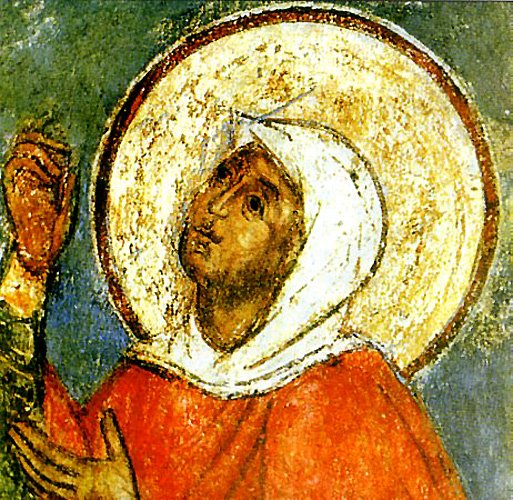
Greatmartyr Euphemia the All-Praised
She was born in Chalcedon to noble Christian parents. When Priscus, the locul Proconsul, celebrated a public sacrifice to Ares, forty-nine Christians including Euphemia hid themselves to avoid idolatry. Their absence was noticed, and they were found and brought before Priscus. After torturing all of them for eleven days, on the twelfth day he singled out Euphemia because of her beauty and began to flatter her, hoping in this way to draw her away from the Faith.
She was born in Chalcedon to noble Christian parents. When Priscus, the locul Proconsul, celebrated a public sacrifice to Ares, forty-nine Christians including Euphemia hid themselves to avoid idolatry. Their absence was noticed, and they were found and brought before Priscus. After torturing all of them for eleven days, on the twelfth day he singled out Euphemia because of her beauty and began to flatter her, hoping in this way to draw her away from the Faith. When his efforts proved useless, he ordered her to be more savagely tortured than any of her fellow believers. She was miraculously preserved intact through many tortures, finally giving her soul into God’s hands when she was thrown to wild beasts. Her devout parents retrieved and buried her body. Her relics are preserved in the Patriarchate of Constantinople.
The miracle wrought by her holy relics at the Council of Chalcedon is commemorated on July 11.
Troparion - Tone 3
You brought joy to the Orthodox / and shame to the defenders of heresy, / for you confirmed what the Fathers of the Fourth Council had correctly taught. / Glorious martyr Euphemia, fair virgin of Christ, / entreat Christ God to grant us His great mercy.
Kontakion - Tone 2
For the sake of Christ your Bridegroom / you underwent struggles in both martyrdom and faith. / Now intercede with the Mother of God / that heresies and the insolent enemies of the Orthodox be placed underfoot. / You received and guarded that which was defined by the six hundred and thirty God-bearing Fathers, / all-praised Euphemia.
Sebastiana, Disciple of St. Paul the Apostle
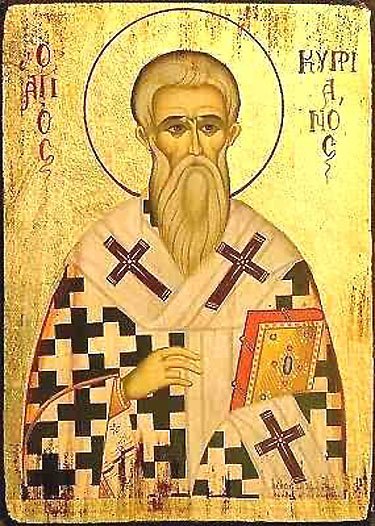
Holy Hieromartyr Cyprian of Carthage (258)
He was born to wealthy and noble parents in Carthage (north Africa), and became a prominent lawyer in that city. Around the year 246 he embraced the Christian faith and was baptized by the priest Caecilianus. Immediately he gave all his goods to the poor and retired to a quiet place in the country to devote himself to prayer and study of Christian writings.
He was born to wealthy and noble parents in Carthage (north Africa), and became a prominent lawyer in that city. Around the year 246 he embraced the Christian faith and was baptized by the priest Caecilianus. Immediately he gave all his goods to the poor and retired to a quiet place in the country to devote himself to prayer and study of Christian writings. In 248 or 249 he was elected Bishop of Carthage by the insistence of the people, though some priests opposed the consecration of such a new Christian.
Soon after his election, the Emperor Decius began a terrible persecution of Christians, during which Cyprian, in hiding, upheld his flock by letters. During this time many Christians gave in to fear of death and either sacrificed to the idols or signed statements that they had done so. When the persecution ended, the problem arose of how to treat the apostates who wished to be received back into the Church. Rigorist groups such as the Novatians and Montanists held that these lapsi had removed themselves from all hope of salvation and could never re-enter the Church. Cyprian rejected this view (as well as the position of some who would immediately reconcile the apostates); he established the position, still standard in the Church, that apostates could be restored after confession and long penance. His position led to a schism in the Church at Carthage when Cyprian’s opponents set up Maximus the Montanist as a rival Bishop. The schism was only ended by a plague that swept the Empire and the city of Carthage in 253-254, together with a renewed persecution of Christians. Saint Cyprian’s tireless care for the suffering during this time won most of the schismatics back to his side. When peace returned, Cyprian called a series of Councils in Carthage to resolve the conflicts that had troubled the Church. He upheld the African (and Eastern) churches’ practice of reconciling heretics to the Church by Baptism rather than by laying on of hands, as was done in Rome; though Cyprian did not seek to impose this practice on other churches, Rome was not so tolerant and broke with the African church until the death of Pope Stephen.
In 256, yet another persecution broke out under the Emperor Valerian. Cyprian was arrested and brought before the Proconsul of the region. He refused to defend himself, and when told that he was to be executed, said only Deo Gratias!(Thanks be to God!). At his execution the holy bishop ordered that twenty-five gold pieces be given to the executioner, and put on the blindfold with his own hands.
Note: St Cyprian is missing on this date from traditional martyrologies because he was once confused with St Cyprian of Antioch (October 2). Today is the date of his martyrdom and the date of his commemoration on the Latin calendar.
Troparion - Tone 4
By sharing in the ways of the Apostles, / you became a successor to their throne. / Through the practice of virtue, you found the way to divine contemplation, O divinely-inspired one; by rightly dividing the word of truth without error, you defended the Faith, / even to the shedding of your blood. / O Hieromartyr Cyprian, entreat Christ God to save our souls.
Kontakion - Tone 4
Guide of Orthodoxy, teacher of piety and holiness, / luminary of Carthage, and divinely-inspired adornment of Confessors. / O wise Cyprian, by your teachings you have enlightened all, O harp of the Spirit. / Pray to Christ God that our souls may be saved.
Melitina the Martyr
St Ninian, Enlightener of Scotland (432)
One of the great missionaries and early Saints of the British Isles, he was born in Britain around the year 360. Though Britain was still mostly pagan, Ninian was born of Christian parents. He traveled to Rome as a young man, and spent several years there engaged in study and ascetic struggle. He was ordained in Rome and sent back as a missionary to Britain around the year 400.
One of the great missionaries and early Saints of the British Isles, he was born in Britain around the year 360. Though Britain was still mostly pagan, Ninian was born of Christian parents. He traveled to Rome as a young man, and spent several years there engaged in study and ascetic struggle. He was ordained in Rome and sent back as a missionary to Britain around the year 400. On the way he probably met St Martin of Tours: many of the churches he founded, including his cathedral in Whithorn, were named in honor of St Martin. He established several monasteries, ministered to his Christian Briton countrymen and converted many more Britons to the Faith. He also converted many of the fierce Picts, inhabitants of today’s Scotland, to faith in Christ. He reposed in peace in Whithorn in 432.
Our Holy Father Dorotheos the Solitary of Egypt (4th c.)
He was one of the great company of Egyptian desert fathers of the fourth century. He lived alone in a cell in the Thebaid for sixty years, devoting himself to prayer, asceticism and renowned love of labor. He spent his days building cells for new monks, his nights making plaited mats, all the while immersed in prayer and psalmody.
Scripture Readings
☩Epistle
Galatians 6:2-10
2
Bear ye one another’s burdens, and so fulfil the law of Christ.
3
For if a man think himself to be something, when he is nothing, he deceiveth himself.
4
But let every man prove his own work, and then shall he have rejoicing in himself alone, and not in another.
5
For every man shall bear his own burden.
6
Let him that is taught in the word communicate unto him that teacheth in all good things.
7
Be not deceived; God is not mocked: for whatsoever a man soweth, that shall he also reap.
8
For he that soweth to his flesh shall of the flesh reap corruption; but he that soweth to the Spirit shall of the Spirit reap life everlasting.
9
And let us not be weary in well doing: for in due season we shall reap, if we faint not.
10
As we have therefore opportunity, let us do good unto all men, especially unto them who are of the household of faith.
☩Gospel
Mark 7:14-24
14
And when he had called all the people unto him, he said unto them, Hearken unto me every one of you, and understand:
15
There is nothing from without a man, that entering into him can defile him: but the things which come out of him, those are they that defile the man.
16
If any man have ears to hear, let him hear.
17
And when he was entered into the house from the people, his disciples asked him concerning the parable.
18
And he saith unto them, Are ye so without understanding also? Do ye not perceive, that whatsoever thing from without entereth into the man, it cannot defile him;
19
Because it entereth not into his heart, but into the belly, and goeth out into the draught, purging all meats?
20
And he said, That which cometh out of the man, that defileth the man.
21
For from within, out of the heart of men, proceed evil thoughts, adulteries, fornications, murders,
22
Thefts, covetousness, wickedness, deceit, lasciviousness, an evil eye, blasphemy, pride, foolishness:
23
All these evil things come from within, and defile the man.
24
And from thence he arose, and went into the borders of Tyre and Sidon, and entered into an house, and would have no man know it: but he could not be hid.
Liturgical data sourced from OCA.org and orthocal.info