Fasting Rules
 Meat
Abstain
Meat
Abstain
 Fish
Abstain
Fish
Abstain
 Dairy
Abstain
Dairy
Abstain
 Oil
Allowed
Oil
Allowed
 Wine
Allowed
Wine
Allowed
Saints & Commemorations
Greatmartyr Catherine of Alexandria
Holy Hieromartyr Clement, Bishop of Rome (ca. 100)
He was instructed in the Faith of Christ by St Peter himself, and may be the Clement mentioned by the Apostle Paul as a fellow-worker in Philippians 4:3. He was consecrated Bishop of Rome about the year 91; some traditions call him the first Bishop of Rome, others the third after Sts Linus and Anacletus.
He was instructed in the Faith of Christ by St Peter himself, and may be the Clement mentioned by the Apostle Paul as a fellow-worker in Philippians 4:3. He was consecrated Bishop of Rome about the year 91; some traditions call him the first Bishop of Rome, others the third after Sts Linus and Anacletus. (This is not necessarily inconsistent: in the Apostolic age, the offices of Elder and Bishop were not strictly distinguished, and the three bishops may have served at the same time or by turns.) He is the author of the Epistle of Clement, which was so highly esteemed in the early Church that it is often found in early versions of the New Testament. The holy Bishop effected countless conversions in Rome, even bringing the Prefect Sisinius and his wife Theodora to the Faith after miraculously healing them of blindness. The bishop’s success so angered the Emperor Trajan that he had Clement exiled to the Crimea, on the far eastern frontier of the Empire. There the holy bishop continued to work wonders of evangelism, founding seventy-five churches in one year and bringing countless pagans to faith in Christ. Finally, to put a stop to the Saint’s work, the Governor of the region had him cruelly tortured, then thrown into the Black Sea with an anchor around his neck. More than 700 years later, in 860, St Cyril (commemorated May 11) arrived in the Crimea, sent by St Photius, Patriarch of Constantinople. He found the relics of St Clement faithfully preserved there and brought part of them back to Constantinople.
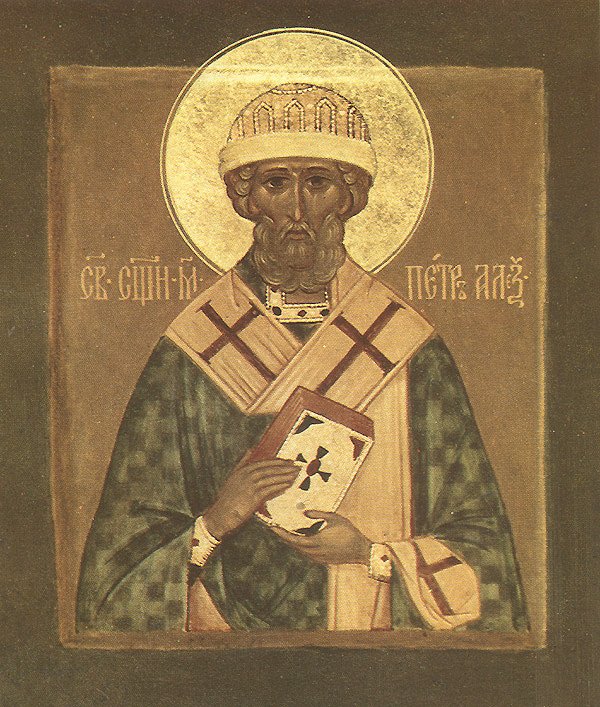
Holy Hieromartyr Peter of Alexandria (312)
The Holy Hieromartyr Peter, Archbishop of Alexandria, was born and raised at Alexandria. He was a highly educated man, and was head of the school of Alexandria. In the year 300 he became the archpastor of the Alexandrian Church, succeeding his teacher and spiritual guide, the holy Bishop Theonas.
Forced into exile from the city during the anti-Christian persecutions under the emperors Diocletian and Maximian, Saint Peter traveled through many lands, encouraging his flock by letter.
The Holy Hieromartyr Peter, Archbishop of Alexandria, was born and raised at Alexandria. He was a highly educated man, and was head of the school of Alexandria. In the year 300 he became the archpastor of the Alexandrian Church, succeeding his teacher and spiritual guide, the holy Bishop Theonas.
Forced into exile from the city during the anti-Christian persecutions under the emperors Diocletian and Maximian, Saint Peter traveled through many lands, encouraging his flock by letter. Again returned to his city, in order to guide the Alexandrian Church personally during this dangerous period. The saint secretly visited Christians locked up in prison, encouraging them to be steadfast in faith, assisting the widows and orphans, preaching the Word of God, constantly praying and officiating at the divine services. And the Lord kept him safe from the hands of the persecutors.
During this time of unrest the iniquitous heretic Arius, who denied the divinity of Jesus Christ, sowed the tares of his impious teaching. When Arius refused to be corrected and submit to the truth, Saint Peter anathematized the heretic and excommunicated him from the Church. Arius then sent two of Saint Peter’s priests to beg the saint to lift the excommunication from him, pretending that he had repented and given up his false teachings. This was not true, for Arius hoped to succeed Saint Peter as Archbishop of Alexandria. Saint Peter, under the guidance of the Holy Spirit, saw through the wickedness and deceit of Arius, and so he instructed his flock not to believe Arius nor to accept him into communion.
Under the wise nurturing of Saint Peter the Church of Alexandria strengthened and grew in spite of the persecutions. But finally, on orders from the emperor Maximian (305-311), the saint was arrested and sentenced to death. A multitude of people gathered at the entrance of the prison, expressing their outrage. Wanting to avoid bloodshed and a riot by the people, the saint sent a message to the authorities, in which he suggested that they make an opening in the back wall of the prison, so that he might be taken away secretly to execution.
In the dark of the night Saint Peter went with the executioners, who took him beyond the city walls and beheaded him at the same spot where formerly Saint Mark had been executed. That night a certain pious virgin heard a Voice from heaven saying, “Peter was first among the Apostles; Peter is the last of the Alexandrian Martyrs.” This took place in the year 311. In the morning, when people learned of the death of their bishop, a crowd gathered at the place of execution. They took up the body and head of the martyr and went to the church, dressing him in his bishop’s vestments, they sat him in his throne at the high place in the altar. During his life Saint Peter never sat on it, but sat on a footstool instead. The saint once explained that whenever he approached his throne he beheld a heavenly light shining on it, and he sensed the presence of a divine power. Therefore, he didn’t dare to sit there.
The Lord Jesus Christ once appeared to Saint Peter as a twelve-year-old child wearing a robe that was torn from top to bottom. Saint Peter asked the Savior who had torn his garment, and He replied, “That madman Arius has torn it by dividing the people whom I have redeemed by My blood. Do not receive him into Communion with the Church, for he has worked evil against Me and My flock.”
Saint Peter, a great champion of Orthodoxy, is known also as a profound theologian. Passages from his book, “On the Divinity (of Jesus Christ)”, were consulted at the Councils of Ephesus and Chalcedon. Of all his works, the most widely known and highly esteemed by the Church are his “Penitential Canons”.
Troparion - Tone 4
O God of our Fathers, / always act with kindness towards us; / take not Your mercy from us, / but guide our lives in peace / through the prayers of the hierarchs Clement and Peter.
Kontakion - Tone 4
Unshakeable and godlike towers of the Church, / truly inspired and mighty pillars of the Faith, / all-praised Clement and Peter, protect us all by your prayers.
Great Martyr Mercurius (ca. 259)
He was born in the province of Asia, to a Scythian who had secretly converted to Christianity. Like his parents, he was a secret follower of Christ, serving as a legionary in the Roman army during the reign of the Emperor Decius. During a campaign, an Angel appeared to him, gave him a sword and told him to go into battle trusting in Christ’s help. M
He was born in the province of Asia, to a Scythian who had secretly converted to Christianity. Like his parents, he was a secret follower of Christ, serving as a legionary in the Roman army during the reign of the Emperor Decius. During a campaign, an Angel appeared to him, gave him a sword and told him to go into battle trusting in Christ’s help. Mercurius plunged into battle, fought his way alone through the enemy lines, and reached the barbarian commander Rigas, whom he killed. Upon the death of their chief the barbarians scattered and the victory was won.
The Emperor, hearing of the young soldier’s exploits, promoted him to a position at court. There, lulled by the pleasures and honors of the court, Mercurius forgot his duties to Christ his King. One night the same Angel who had given him the sword appeared to him once again and reminded him of the sword that Christ had given him, an emblem of the battle of martyrdom that he was about to enter. The next day Mercurius, now returned to his senses, refused to offer sacrifice to the gods. When called before the Emperor, he boldly proclaimed Christ and threw off his badges of office. He was thrown in prison and subjected to cruel tortures, all of which he bore with peace and joy, encouraged by the Angel who appeared to him again to offer comfort and encouragement. After long torment he was beheaded in Caesarea in Cappadocia, at the age of twenty-five.
Holy Martyr Mercurius of Smolensk (1238)
He was a soldier from Byzantium, one of the defenders of Smolensk when it was besieged by the Tatars in 1238. One day the Mother of God appeared to Mercurius and told him that the Tatars were preparing a surprise attack — and, further, that he must take up arms and attack the enemy singlehandedly. Placing all his trust in God, the lone soldier threw himself against the Tatar host crying ‘Most Holy Mother of God, help me!’ He was quickly surrounded and cut down, and it appeared that his action had been as foolhardy as it had seemed, when a woman at the head of a glorious host, all of them surrounded by light, appeared and threw back the Tatar army. The n
He was a soldier from Byzantium, one of the defenders of Smolensk when it was besieged by the Tatars in 1238. One day the Mother of God appeared to Mercurius and told him that the Tatars were preparing a surprise attack — and, further, that he must take up arms and attack the enemy singlehandedly. Placing all his trust in God, the lone soldier threw himself against the Tatar host crying ‘Most Holy Mother of God, help me!’ He was quickly surrounded and cut down, and it appeared that his action had been as foolhardy as it had seemed, when a woman at the head of a glorious host, all of them surrounded by light, appeared and threw back the Tatar army. The next morning the people of Smolensk found the ground covered with the bodies of their enemies. They buried Mercurius in the Cathedral, where he has been venerated as a Martyr ever since.
Scripture Readings
☩Epistle
1 Timothy 1:8-14
8
But we know that the law is good, if a man use it lawfully;
9
Knowing this, that the law is not made for a righteous man, but for the lawless and disobedient, for the ungodly and for sinners, for unholy and profane, for murderers of fathers and murderers of mothers, for manslayers,
10
For whoremongers, for them that defile themselves with mankind, for menstealers, for liars, for perjured persons, and if there be any other thing that is contrary to sound doctrine;
11
According to the glorious gospel of the blessed God, which was committed to my trust.
12
And I thank Christ Jesus our Lord, who hath enabled me, for that he counted me faithful, putting me into the ministry;
13
Who was before a blasphemer, and a persecutor, and injurious: but I obtained mercy, because I did it ignorantly in unbelief.
14
And the grace of our Lord was exceeding abundant with faith and love which is in Christ Jesus.
☩Gospel
Luke 17:26-37
26
And as it was in the days of Noe, so shall it be also in the days of the Son of man.
27
They did eat, they drank, they married wives, they were given in marriage, until the day that Noe entered into the ark, and the flood came, and destroyed them all.
28
Likewise also as it was in the days of Lot; they did eat, they drank, they bought, they sold, they planted, they builded;
29
But the same day that Lot went out of Sodom it rained fire and brimstone from heaven, and destroyed them all.
30
Even thus shall it be in the day when the Son of man is revealed.
31
In that day, he which shall be upon the housetop, and his stuff in the house, let him not come down to take it away: and he that is in the field, let him likewise not return back.
32
Remember Lot’s wife.
33
Whosoever shall seek to save his life shall lose it; and whosoever shall lose his life shall preserve it.
34
I tell you, in that night there shall be two men in one bed; the one shall be taken, and the other shall be left.
35
Two women shall be grinding together; the one shall be taken, and the other left.
36
Two men shall be in the field; the one shall be taken, and the other left.
37
And they answered and said unto him, Where, Lord? And he said unto them, Wheresoever the body is, thither will the eagles be gathered together.
Liturgical data sourced from OCA.org and orthocal.info