Fasting Rules

Meat allowed Meat Allowed
Fish allowed Fish Allowed
Dairy allowed Dairy Allowed
Oil allowed Oil Allowed
Wine allowed Wine Allowed

☦ Saints & Commemorations

Saturday before Theophany
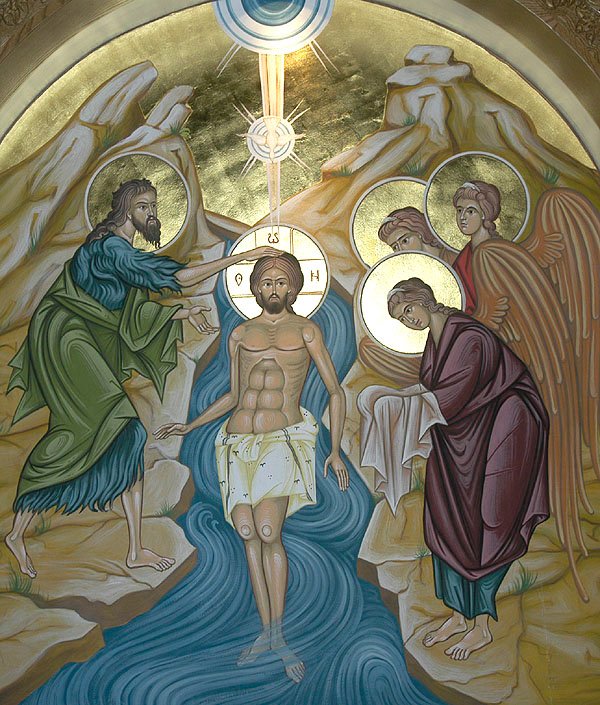
Forefeast of Theophany

Forefeast of Theophany

The second day of the Forefeast of Theophany falls on January 3. Today’s hymns invite us to go in spirit to the Jordan River where the Creator comes to be baptized. He is the Light which shines in the darkness (John 1:5), and today He begins to overcome that darkness.

Troparion - Tone 4

Prepare, O Zebulon, / and adorn yourself, O Naphtali; / River Jordan, cease flowing / and receive with joy the Master coming to be baptized. / Adam, rejoice with our First Mother / and do not hide yourself as you did of old in Paradise; / for having seen you naked, / He has appeared to clothe you with the first garment. / Christ has appeared to renew all creation.

Kontakion - Tone 4

Today the Lord enters the Jordan and cries out to John: / “Do not be afraid to baptize me. / For I have come to save Adam, the first-formed man.”
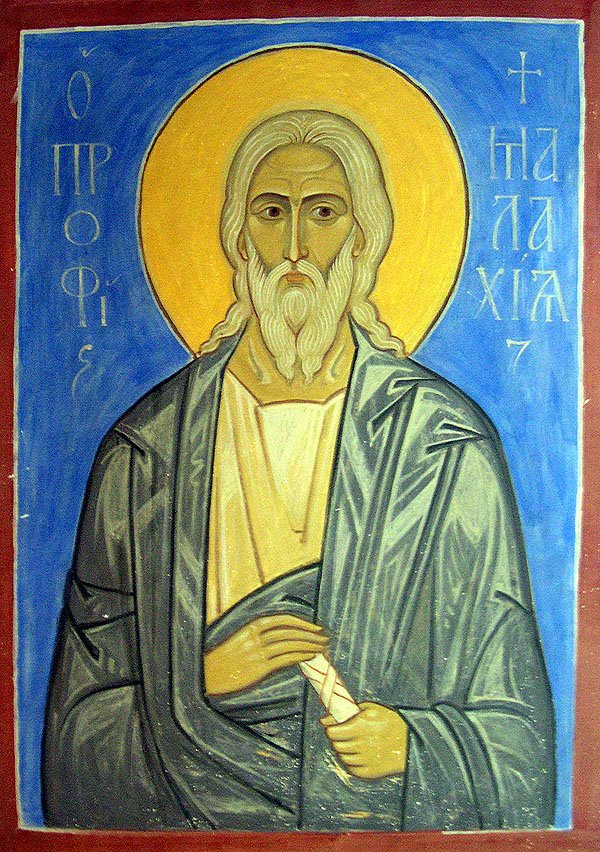
Prophet Malachi

Prophet Malachi

The Holy Prophet Malachi lived 400 years before the Birth of Christ, at the time of the return of the Jews from the Babylonian Captivity. Malachi was the last of the Old Testament prophets, therefore the holy Fathers call him “the seal of the prophets.” Manifesting himself an image of spiritual goodness and piety, he astounded the nation and was called Malachi, i.e., an angel. His The Holy Prophet Malachi lived 400 years before the Birth of Christ, at the time of the return of the Jews from the Babylonian Captivity. Malachi was the last of the Old Testament prophets, therefore the holy Fathers call him “the seal of the prophets.” Manifesting himself an image of spiritual goodness and piety, he astounded the nation and was called Malachi, i.e., an angel. His prophetic book is included in the Canon of the Old Testament. In it he upbraids the Jews, foretelling the coming of Jesus Christ and His Forerunner, and also the Last Judgment (Mal 3:1-5; 4:1-6).

Troparion - Tone 2

We celebrate the memory / of Your prophet Malachi, O Lord; / through him we entreat You, / save our souls.

Kontakion - Tone 4

Endowed with the gift of prophecy, O Malachi, / you clearly proclaimed the saving coming of Christ to the world. / His brightness has brought light to the whole universe.
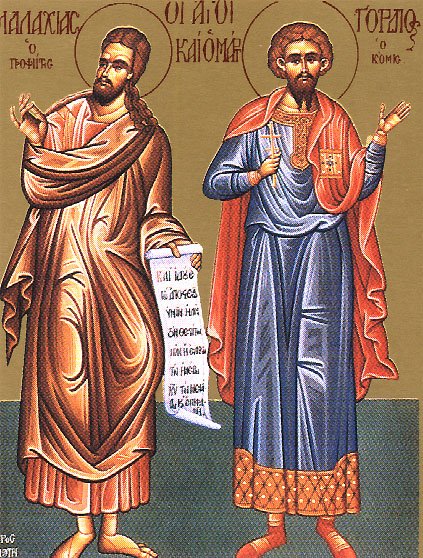
Holy Martyr Gordius of Caesarea (4th c.)

Holy Martyr Gordius of Caesarea (4th c.)

The Martyr Gordius was born at the end of the third century in the city of Caesarea of Cappadocia into a Christian family. When he came of age, he entered military service. Because of his valor and military skill, he was made a centurion. During the persecution of Christians at the beginning of the fourth century, he left the world and settled in the Sinai desert to prepare himself for the good deed of confessing the Name of Christ the Savior. The Martyr Gordius was born at the end of the third century in the city of Caesarea of Cappadocia into a Christian family. When he came of age, he entered military service. Because of his valor and military skill, he was made a centurion. During the persecution of Christians at the beginning of the fourth century, he left the world and settled in the Sinai desert to prepare himself for the good deed of confessing the Name of Christ the Savior. In the year 320, Gordius openly appeared before the prefect of a city where pagan games were being held, and identified himself as a Christian. He was arrested, suffered terrible torments, then was beheaded.

Troparion - Tone 4

Your holy martyr Gordius, O Lord, / through his suffering has received an incorruptible crown from You, our God. / For having Your strength, he laid low his adversaries, / and shattered the powerless boldness of demons. / Through his intercessions, save our souls!

Kontakion - Tone 8

Holy Gordius, the earth has received the sweat of your labors; / the blood you shed has made the universe rejoice. / Save by your prayers those who sing of your glory in faith, / fittingly honoring you, divine and glorious martyr, worthy of all praise.
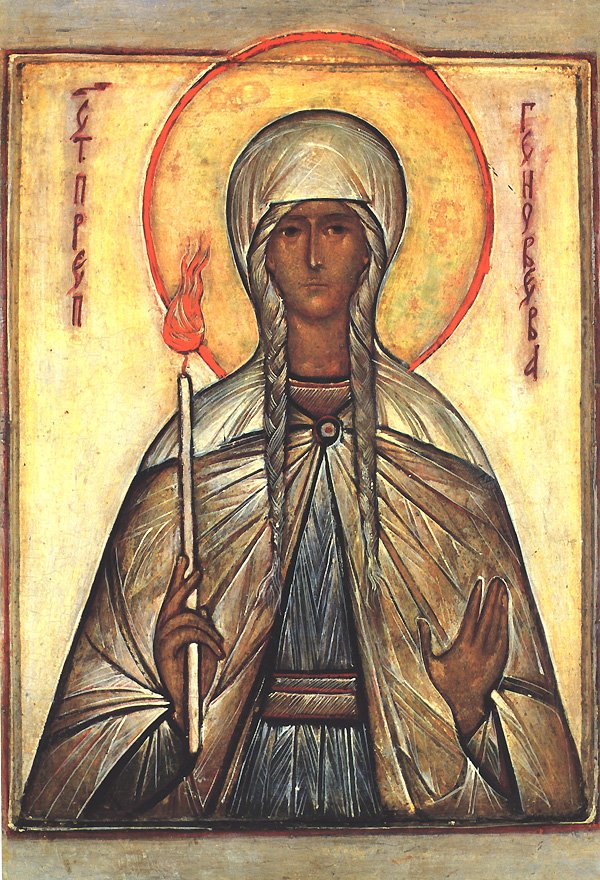
Our Holy Mother Genevieve of Paris (ca. 502)

Our Holy Mother Genevieve of Paris (ca. 502)

Saint Genevieve (Geneviève) was born of wealthy parents in Gaul (modern France) in the village of Nanterre, near Paris, around 422. Her father’s name was Severus, and her mother was called Gerontia. According to the custom of the time, she often tended her father’s sheep on Mount Valerien. When the child was about seven years old, Saint Germanus of Auxerre (July 31) noticed her as he was passing through Nanterre. Duri Saint Genevieve (Geneviève) was born of wealthy parents in Gaul (modern France) in the village of Nanterre, near Paris, around 422. Her father’s name was Severus, and her mother was called Gerontia. According to the custom of the time, she often tended her father’s sheep on Mount Valerien. When the child was about seven years old, Saint Germanus of Auxerre (July 31) noticed her as he was passing through Nanterre. During the Service that night the Bishop placed his hand on her head and told her parents that she would become great in the sight of God, and would lead many to salvation. When Genevieve told him that she wished to dedicate herself to Christ, he gave her a brass medal with the image of the Cross to wear around her neck. Saint Germanus told her never to wear bracelets, or necklaces made with pearls, gold, or silver, and to avoid wearing any other ornaments around her neck, or on her fingers. When she was fifteen, Genevieve was taken to Paris to enter the monastic life. Through fasting,vigil and prayer, she progressed in monasticism, and received from God the gifts of clairvoyance and of working miracles. Gradually, the people of Paris and the surrounding area regarded Genevieve as a holy vessel (2 Timothy 2:21). Years later, Saint Genevieve was told that Attila the Hun was approaching Paris, Genevieve and the other nuns prayed and fasted, entreating God to spare the city. Suddenly, the barbarians turned away from Paris and went off in another direction. Saint Genevieve considered the Saturday night Vigil service to be very important, since it symbolizes how our entire life should be. “We must keep vigil in prayer and fasting so that the Lord will find us ready when He comes,” she said. She was on her way to church with her nuns one stormy Saturday night when the wind extinguished her lantern. The nuns could not find their way without a light, since it was dark and stormy, and the road was rough and muddy. Saint Genevieve made the Sign of the Cross over the lantern, and the candle within burned with a bright flame. In this manner they were able to make their way to the church for the service. There is a tradition that the church which Saint Genevieve suggested King Clovis should build in honor of Saints Peter and Paul, would become her own resting place when she fell asleep in the Lord around 512 at the age of eighty-nine. Her holy relics were later transferred to the church of Saint-Étienne-du-Mont in Paris. Most of her relics, and those of other saints, were destroyed at the time of the French Revolution. During the Middle Ages, Saint Genevieve was regarded as the patron Saint of wine makers.

Troparion - Tone 1

Your abundant tears have watered and made fertile the desert of barren hearts, / your prayers and sighs have produced fruit a hundredfold. / Pray for your city, O Saint Geneviève, / and for those who lovingly venerate your holy memory.

Kontakion

O Shepherdess and guardian of the flock at Nanterre against the horde of wolves and the Scourge of God,1 / you are the protector of the city of Paris. / O Saint Geneviève, do not forget to preserve your spiritual flock even now, / from Heaven where you live after death.1 Attila the Hun.

Scripture Readings

☩Epistle

Ephesians 5:1-8

1 Be ye therefore followers of God, as dear children;
2 And walk in love, as Christ also hath loved us, and hath given himself for us an offering and a sacrifice to God for a sweetsmelling savour.
3 But fornication, and all uncleanness, or covetousness, let it not be once named among you, as becometh saints;
4 Neither filthiness, nor foolish talking, nor jesting, which are not convenient: but rather giving of thanks.
5 For this ye know, that no whoremonger, nor unclean person, nor covetous man, who is an idolater, hath any inheritance in the kingdom of Christ and of God.
6 Let no man deceive you with vain words: for because of these things cometh the wrath of God upon the children of disobedience.
7 Be not ye therefore partakers with them.
8 For ye were sometimes darkness, but now are ye light in the Lord: walk as children of light:

☩Gospel

Luke 17:3-10

3 Take heed to yourselves: If thy brother trespass against thee, rebuke him; and if he repent, forgive him.
4 And if he trespass against thee seven times in a day, and seven times in a day turn again to thee, saying, I repent; thou shalt forgive him.
5 And the apostles said unto the Lord, Increase our faith.
6 And the Lord said, If ye had faith as a grain of mustard seed, ye might say unto this sycamine tree, Be thou plucked up by the root, and be thou planted in the sea; and it should obey you.
7 But which of you, having a servant plowing or feeding cattle, will say unto him by and by, when he is come from the field, Go and sit down to meat?
8 And will not rather say unto him, Make ready wherewith I may sup, and gird thyself, and serve me, till I have eaten and drunken; and afterward thou shalt eat and drink?
9 Doth he thank that servant because he did the things that were commanded him? I trow not.
10 So likewise ye, when ye shall have done all those things which are commanded you, say, We are unprofitable servants: we have done that which was our duty to do.

Liturgical data sourced from OCA.org and orthocal.info