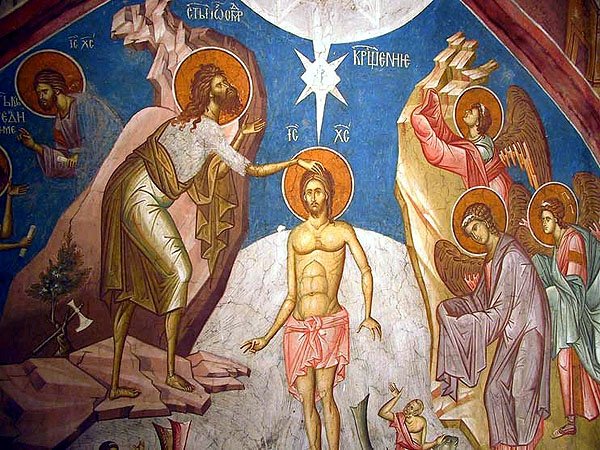
The third day of the Forefeast of Theophany falls on January 4. The hymns compare the Feast of the Nativity with the coming Feast. “There shepherds saw the Child and were amazed; here the voice of the Father proclaims the only-begotten Son.”
Troparion - Tone 4
Prepare, O Zebulon, / and adorn yourself, O Naphtali; / river Jordan, cease flowing / and receive with joy the Master coming to be baptized. / Adam, rejoice with our First Mother / and do not hide yourself as you did of old in Paradise; / for having seen you naked, / He has appeared to clothe you with the first garment. / Christ has appeared to renew all creation.
Kontakion - Tone 4
Today the Lord enters the Jordan and cries out to John: / “Do not be afraid to baptize me. / For I have come to save Adam, the first-formed man.”
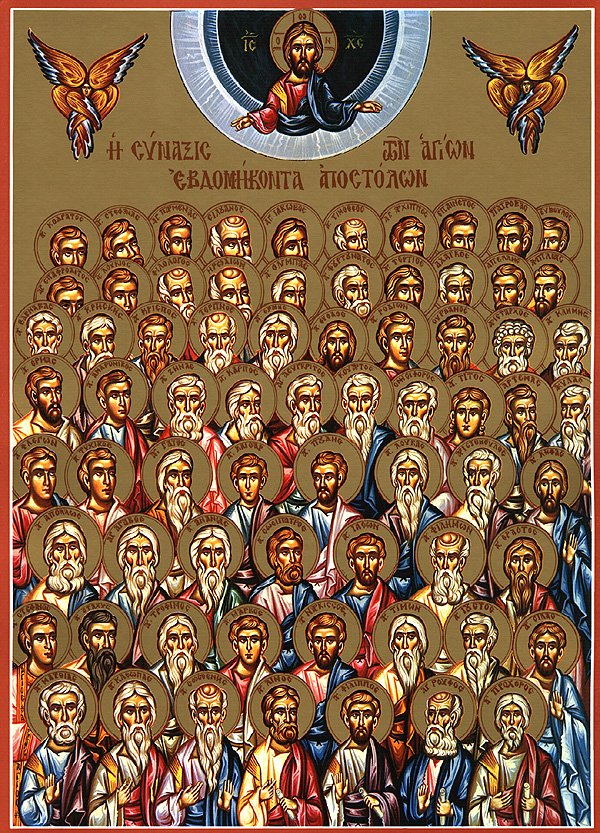
Synaxis of Seventy Apostles
The Synaxis of the Seventy Apostles was established by the Orthodox Church to indicate the equal honor of each of the Seventy. They were sent two by two by the Lord Jesus Christ to go before Him into the cities He would visit (Luke 10:1).
Besides the celebration of the Synaxis of the Holy Disciples, the Church celebrates the memory of each of them during the course of the year:
Saint James the Brother of the Lord ( October 23 ); Mark the Evangelist ( April 25 ); Luke the Evangelist ( October 18 ); Cleopas (October 30), brother of Saint Joseph the Betrothed, and Simeon his son ( April 27 ); Barnabas ( June 11 ); Joses, or Joseph, named Barsabas or Justus ( October 30 ); Thaddeus ( August 21 ); Ananias ( October 1 ); Protomartyr Stephen the Archdeacon ( December 27 ); Philip the Deacon ( October 11 ); Prochorus the Deacon ( July 28 ); Nicanor the Deacon ( July 28 and December 28 ); Timon the Deacon ( July 28 and December 30 ); Parmenas the Deacon ( July 28 ); Timothy ( January 22 ); Titus ( August 25 ); Philemon ( November 22 and February 19 ); Onesimus ( February 15 ); Epaphras and Archippus ( November 22 and February 19 ); Silas , Silvanus , Crescens or Criscus (July 30); Crispus and Epaenetos (July 30); Andronicus ( May 17 and July 30 ); Stachys, Amplias, Urban, Narcissus, Apelles ( October 31 ); Aristobulus ( October 31 and March 16 ); Herodion or Rodion ( April 8 and November 10 ); Agabus, Rufus, Asyncritus, Phlegon ( April 8 ); Hermas ( November 5 , November 30 and May 31 ); Patrobas ( November 5 ); Hermes ( April 8 ); Linus, Gaius, Philologus ( November 5 ); Lucius ( September 10 ); Jason ( April 28 ); Sosipater ( April 28 and November 10 ); Olympas or Olympanus ( November 10 ); Tertius ( October 30 and November 10 ); Erastos (November 30), Quartus ( November 10 ); Euodius ( September 7 ); Onesiphorus ( September 7 and December 8 ); Clement ( November 25 ); Sosthenes ( December 8 ); Apollos ( March 30 and December 8 ); Tychicus, Epaphroditus ( December 8 ); Carpus ( May 26 ); Quadratus ( September 21 ); Mark ( September 27 ), called John, Zeno ( September 27 ); Aristarchus ( April 15 and September 27 ); Pudens and Trophimus (April 15); Mark nephew of Barnabas , Artemas (October 30); Aquila ( July 14 ); Fortunatus ( June 15 ) and Achaicus (January 4).
With the Descent of the Holy Spirit the Seventy Apostles preached in various lands. Some accompanied the Twelve Apostles, like the holy Evangelists Mark and Luke, or Saint Paul ’s companion Timothy, or Prochorus, the disciple of the holy Evangelist John the Theologian , and others. Many of them were thrown into prison for Christ, and many received the crown of martyrdom.
There are two more Apostles of the Seventy: Saint Cephas , to whom the Lord appeared after the Resurrection (1 Cor. 15:5-6), and Simeon, called Niger (Acts 13:1). They also were glorified by apostolic preaching.
There are discrepancies and errors in some lists of the Seventy Apostles. In a list attributed to Saint Dorotheus of Tyre (June 5) some names are repeated (Rodion, or Herodion, Apollos, Tychicus, Aristarchus), while others are omitted (Timothy, Titus, Epaphras, Archippus, Aquila, Olympas). Saint Demetrius of Rostov consulted the Holy Scripture, the traditions passed down by the Fathers, and the accounts of trustworthy historians when he attempted to correct the mistakes and uncertainties in the list in compiling his collection of Lives of the Saints.
The Church in particular venerates and praises the Seventy Apostles because they taught us to honor the Trinity One in Essence and Undivided.
In the ninth century Saint Joseph the Hymnographer composed the Canon for the Synaxis of the Seventy Apostles of Christ.
Troparion - Tone 3
Holy apostles of the Seventy, / entreat the merciful God / to grant our souls forgiveness of transgressions.
Kontakion - Tone 2
O faithful, let us praise with hymns / the choir of the seventy disciples of Christ. / They have taught us all to worship the undivided Trinity, / for they are divine lamps of the Faith.
Our Righteous Father Theoctistus, Abbot of Cucomo in Sicily
Saint Theoktistos lived in the second half of the eighth century, during a period of widespread iconoclastic heresy. The Venerable One was the founder and Igoumen of Cucomo Monastery on the island of Sicily. During that difficult time for the Church, the Orthodox were persecuted by iconoclastic Emperors.
Saint Theoktistos lived in the second half of the eighth century, during a period of widespread iconoclastic heresy. The Venerable One was the founder and Igoumen of Cucomo Monastery on the island of Sicily. During that difficult time for the Church, the Orthodox were persecuted by iconoclastic Emperors. Orthodox churches were closed, and the Holy Icons were desecrated and destroyed. The monks, in particular, were affected by the iconoclastic persecution because they protected the Holy Icons. The monks were expelled from their monasteries, which were destroyed, and they were forced to flee their homeland. Saint Theoktistos sheltered these Greek monks in his monastery.
The Seventh Ecumenical Council, which was convened in 787, condemned the iconoclast heresy, but even after that, the heresy, supported by iconoclastic Emperors, continued to disturb the peace of the Church. Only in the reign of the Holy Empress Theodora , at the Council of 842, was iconoclasm finally condemned. The Triumph of Orthodoxy was appointed to be celebrated every year on the first Sunday of Great Lent.
Saint Theoktistos did not live to see that Triumph, for he fell asleep in the Lord in the year 800.
Saint Theoktistos of Sicily should not be confused with Saint Theoktistos of Palestine (September 3), the companion of Saint Euthymios (January 20) in the ascetic life.
Troparion - Tone 8
By a flood of tears you made the desert fertile, / and your longing for God brought forth fruits in abundance. / By the radiance of miracles you illumined the whole universe! / O our holy Father Theoktistos, pray to Christ our God to save our souls!
Nikephoros the Leper
New Martyr Onuphrios
Righteous Euthymios of Vatopedi
Eustathios Archbishop of Serbia
The Ethiopian Eunuch of Queen Candace
His baptism by the holy Apostle Philip is told in Acts ch. 8. He was already seeking out the things of God — the story shows him reading the Book of Isaiah, and specifies that he was going to Jerusalem to worship. He returned home (“rejoicing”, say the scriptures) and proclaimed the Gospel of Christ in his native land; the ancient Church of Ethiopia traces its beginnings to his mission. He di
His baptism by the holy Apostle Philip is told in Acts ch. 8. He was already seeking out the things of God — the story shows him reading the Book of Isaiah, and specifies that he was going to Jerusalem to worship. He returned home (“rejoicing”, say the scriptures) and proclaimed the Gospel of Christ in his native land; the ancient Church of Ethiopia traces its beginnings to his mission. He died a martyr’s death.
Venerable Apollinaria (5th c.)
She was a maiden of high rank, the daughter of a magistrate named Anthimus in the city of Rome. Filled with love for Christ, she prevailed on her parents to allow her to travel on pilgrimage to the Holy Land. In Jerusalem she dismissed most of her attendants, gave her jewels, fine clothes and money to the poor, and went on to Egypt accompanied only by two trusted servants.
She was a maiden of high rank, the daughter of a magistrate named Anthimus in the city of Rome. Filled with love for Christ, she prevailed on her parents to allow her to travel on pilgrimage to the Holy Land. In Jerusalem she dismissed most of her attendants, gave her jewels, fine clothes and money to the poor, and went on to Egypt accompanied only by two trusted servants. Near Alexandria she slipped away from them and fled to a forest, where she lived in ascesis for many years. She then made her way to Sketis, the famous desert monastic colony, and presented herself as a eunuch named Dorotheos. In this guise she was accepted as a monk.
Anthimus, having lost his elder daughter, was visited with another grief: his younger daughter was afflicted by a demon. He sent this daughter to Sketis, asking the holy fathers there to aid her by their prayers. They put her under the care of “Dorotheos”, who after days of constant prayer effected the complete cure of her (unknowing) sister. When the girl got back home it was discovered that she was pregnant, and Anthimus angrily ordered that the monk who had cared for her be sent to him. He was astonished to find that “Dorotheos” was his own daughter Apollinaria, whom he had abandoned hope of seeing again. After some days the holy woman returned to Sketis, still keeping her identity secret from her fellow-monks. Only at her death was her true story discovered.
Scripture Readings
☩Epistle
2 Timothy 4:5-8
5
But watch thou in all things, endure afflictions, do the work of an evangelist, make full proof of thy ministry.
6
For I am now ready to be offered, and the time of my departure is at hand.
7
I have fought a good fight, I have finished my course, I have kept the faith:
8
Henceforth there is laid up for me a crown of righteousness, which the Lord, the righteous judge, shall give me at that day: and not to me only, but unto all them also that love his appearing.
☩Gospel
Mark 1:1-8
1
The beginning of the gospel of Jesus Christ, the Son of God;
2
As it is written in the prophets, Behold, I send my messenger before thy face, which shall prepare thy way before thee.
3
The voice of one crying in the wilderness, Prepare ye the way of the Lord, make his paths straight.
4
John did baptize in the wilderness, and preach the baptism of repentance for the remission of sins.
5
And there went out unto him all the land of Judea, and they of Jerusalem, and were all baptized of him in the river of Jordan, confessing their sins.
6
And John was clothed with camel’s hair, and with a girdle of a skin about his loins; and he did eat locusts and wild honey;
7
And preached, saying, There cometh one mightier than I after me, the latchet of whose shoes I am not worthy to stoop down and unloose.
8
I indeed have baptized you with water: but he shall baptize you with the Holy Ghost.

 Meat
Allowed
 Fish
Allowed
 Dairy
Allowed
 Oil
Allowed
 Wine
Allowed